
National Stress Awareness Day guide. Five short exercises that calm your nervous system during a stressful workday, with the research behind each one.
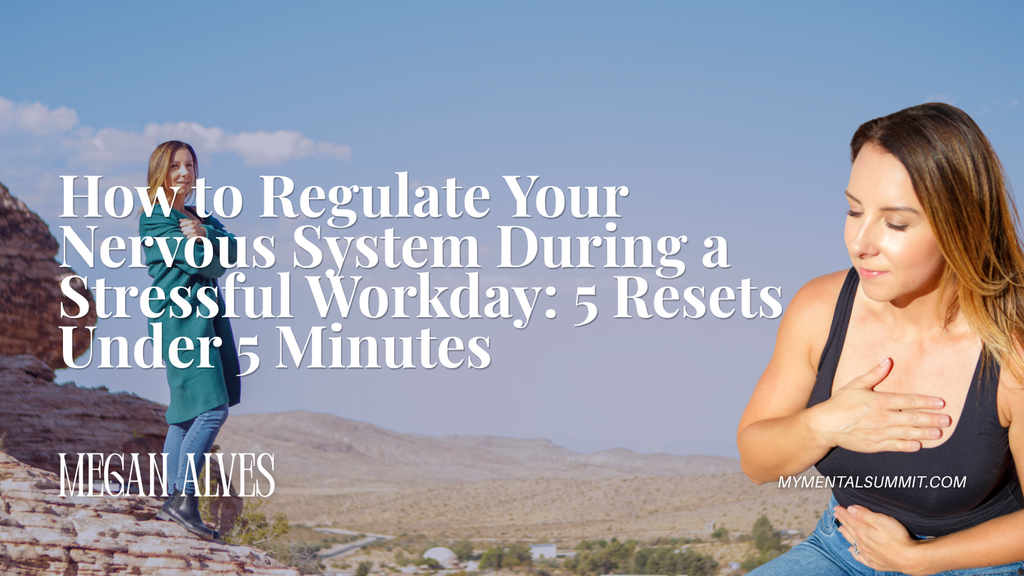
Today is National Stress Awareness Day, observed on the first Wednesday of November. Roughly 40% of employees worldwide reported a lot of stress the previous day in Gallup’s 2026 workplace report, and 54% of U.S. workers told the APA that job insecurity significantly affects their stress at work. Stress at that scale needs a fix that fits inside the workday.
Regulating your nervous system at work means helping your body come down after something spikes it: the email, the meeting, the notification. This post gives you five resets you can do at your desk, in a hallway or in a parked car. The evidence for short practices is decent. In a randomized trial, five minutes a day of breathwork improved mood more than the same time spent on mindfulness meditation. A meta-analysis of 22 samples found that breaks of ten minutes or less reduced fatigue and raised vigor, although the effects were small.
Why Short Resets Are Worth Your Time
Stress shows up in the body first. Breathing speeds up, muscles brace, heart rate climbs. Each reset below goes in through one of those channels: breath, words, movement or muscle tension. Most of the studies behind them used longer or repeated practice, and some are small, so treat the times here as starting doses. The order follows how a stressful day tends to go.
5 Resets for a Stressful Workday
Reset 1: Lengthen Your Exhale Before You Open Your Inbox
When: first thing, before email or Slack. Time: 1 to 2 minutes.
Breathe in through your nose for a count of four and out for a count of six. That works out to about six breaths a minute. A systematic review of 15 studies found that slow breathing, under 10 breaths a minute, raised heart rate variability and was linked to more relaxation and less anxiety and anger. If counting makes you tense, drop the count and just make the exhale longer than the inhale. If you feel dizzy, go back to normal breathing.
Reset 2: Try Cyclic Sighing Before a Hard Meeting
When: a few minutes before a tough meeting or conversation. Time: 1 to 2 minutes.
Breathe in through your nose, then add a second short sip of air on top. Let it all out through your mouth, slowly. Repeat. In the same trial, people practiced one of three breathing exercises or mindfulness meditation for five minutes a day for a month. Cyclic sighing, the exhale-heavy one, did best at improving mood and slowing breathing rate. Nobody tested a one-minute pre-meeting round, so that part is borrowed from the study and unproven.
Reset 3: Name the Feeling in the Middle of the Spike
When: your jaw or chest tightens mid-conversation. Time: 10 seconds.
Silently finish the sentence “Right now I feel…” and be specific. “Pressured” or “dismissed” gives you more to work with than “stressed.” In a brain imaging study, putting a feeling into words dampened the amygdala’s response compared with other tasks. A later review links labeling to changes in heart rate, and the researchers say the mechanisms are still early work. Naming the feeling lowers the volume. The problem is still there when you finish, and you handle it from a calmer body.
Reset 4: Walk for Five Minutes After a Rough Call
When: after a call or meeting that leaves you wired. Time: 5 minutes.
Stand up, leave the room and walk at an easy pace. Leave your phone on the desk. Short breaks had small but significant effects on fatigue and vigor in the meta-analysis, with no overall effect on task performance, so the gain here is feeling less drained. In a small Columbia lab trial of 11 adults, five minutes of walking every 30 minutes of sitting was the best dose for blood pressure, and nearly every walking schedule they tested cut fatigue and improved mood. You don’t need that frequency. Start with once or twice a day.
Reset 5: Tense and Release Your Muscles at Your Desk
When: mid-afternoon, or when your shoulders have crept up to your ears. Time: 3 to 5 minutes.
Work from your feet up to your jaw. Tense one muscle group for about five seconds, let go, and notice the difference before you move on. This is progressive muscle relaxation. A systematic review of 46 publications covering more than 3,400 adults found it reduced stress and anxiety, alone or combined with other approaches. Skip any area that is injured or painful.
Fit the Resets Into a Real Day
Don’t try all five on day one. Pick the moment your day usually goes sideways and attach one reset to it. If the 2 p.m. meeting is the spike, start with Reset 2. If the inbox is the spike, start with Reset 1. After a week, add a second one. Put a recurring calendar reminder on the ones that are easy to forget, like the walk and the muscle release.
These are for ordinary workday stress. If stress is keeping you from sleeping, working or functioning on most days, a therapist or your doctor can do more than a breathing exercise.
What to Do Next
Pick one step and try it for a week. Rate your stress from 1 to 10 before and after each time. Small drops add up, and the log shows you which exercise works best for you. If your stress stays high every day, or comes with panic, trouble sleeping, or low mood, talk with a licensed clinician.
Workday stress shows up in the body, so every exercise here starts in the body. Short and specific practice, repeated often, does more than a long routine you never get to.
If you want guided support, Elevate has two places to start. The 5-Day Emotional Reset Challenge, led by Megan, offers grounding practices and reflection prompts in about 15 minutes a day. The Emotional and Psychological Well-Being Course covers emotional intelligence, cognitive behavioral techniques, mindfulness, stress management, and anxiety tools in more depth.
Join Elevate.
If you want this kind of session for your team or organization, reach out at mymentalsummit.com.